John Colloton, former chief executive for UI Hospitals & Clinics and VP for statewide health services, dies at age 94
Iowa native helped transform the university’s patient care enterprise — setting the stage for what UI Health Care is today

John William Colloton, whose vision and leadership spanning over four decades established the University of Iowa’s hospital as one of the world’s premier medical centers, died Friday, Nov. 14, in Iowa City. He was 94 years old.
For most Iowans, Colloton personified the emergence of UI Hospitals & Clinics — now known as UI Health Care Medical Center — as a tertiary and quaternary care facility, teaching and research hospital, and health care resource for patients across the state and region.
It’s a level of recognition and appreciation that extends beyond the UI Health Care medical center pavilion that bears his name.
Beginning as an administrative resident at what was then known as University Hospitals, Colloton advanced to become the hospital director in 1971 — the youngest person ever selected for the top role in the hospital’s administration. His appointment marked the start of a two-decade period (1971-1993) of hospital leadership and unprecedented growth in medical personnel and services and the construction of modern-era patient care facilities. These capital improvements were vital to recruiting and retaining physicians and other health professionals and establishing programs of world-class medical care for patients.
As assistant and associate hospital director in the 1960s, Colloton played a lead role in preserving state support during the establishment of Medicare and Medicaid programs. He also was actively involved in plans that led to the approval of bonding authority for University Hospitals to finance future construction projects.

“It’s truly remarkable when you consider the impact John Colloton made on our health care system, the university as a whole, and the health and well-being of Iowans and their families,” says Denise Jamieson, MD, MPH, UI vice president for medical affairs and the Tyrone D. Artz Dean of the Carver College of Medicine. “So much of what UI Health Care represents today can be traced back to his vision. He cared deeply about the university and our health system — and it’s because he cared so much about Iowa and its people.”
During Colloton’s tenure as hospital director, it’s estimated that three out of five Iowa families received care at or through UI Hospitals & Clinics. During this same era, seven out of 10 Iowa doctors received all or part of their medical education and training through the university.
The transformation of the patient care enterprise under Colloton’s leadership — the construction of new facilities and infrastructure, increased staffing levels of medical personnel, expansion of medical specialty and subspecialty services, establishment of outreach clinics in communities around the state, and yearly increases in the total numbers of patients served — was remarkable.
His phased, pay-as-you-go approach to major capital projects, based on a combination of bonding and capital reserves (versus all-or-nothing funding models that relied primarily on state and federal appropriations), was equally impressive.
Early years and education
Colloton was born on Feb. 20, 1931, in Mason City, Iowa, the third of five children. A profile by the Horatio Alger Association, which honored Colloton as a member of its 2002 class of Horatio Alger Award recipients, noted that his parents were grandchildren of Irish immigrants. Colloton’s father worked as a machinist with the Milwaukee Railroad.
“My parents conveyed solid values to us,” Colloton said in the article. “Hard work was a virtue in their minds, and integrity was important. They taught us to have humility and to be considerate of others.”
Colloton enrolled at Loras College in Dubuque, Iowa, graduating magna cum laude with a degree in business administration in 1953. After graduation, he joined the U.S. Army. Returning home two years later, Colloton used the GI bill to pursue a master’s degree in hospital administration at the University of Iowa, which he earned in 1957.
Leading an era of unprecedented expansion and growth
Colloton steadily moved up the administrative ladder at University Hospitals, beginning in the late 1950s and continuing throughout the 1960s.
By the time he became director in 1971, he was highly experienced in hospital management, having worked closely for years with his predecessor, Gerhard Hartman, as assistant and associate hospital director.
Throughout much of its history, University Hospitals operated primarily as an indigent care referral facility, and many Iowans with the means or insurance to pay for care chose private hospitals or traveled out of state. With the establishment of Medicare and Medicaid in the mid-1960s, older and low-income Iowans could get care in their local communities. It was a shift that could have reduced the number of patients coming to University Hospitals, especially in relation to its role as a teaching and research facility.
Under Colloton’s leadership, Medicare/Medicaid reimbursements to University Hospitals for patient care services were investments that helped support additional specialty care programs — giving Iowans greater access to health care services while continuing to support educational and training opportunities.

To facilitate growth in programs and people, he needed to address the declining physical condition and space limitations of existing hospital facilities. General Hospital, which opened in 1928, could no longer adequately meet the needs of late 20th-century academic medicine. Colloton’s goal was to expand and modernize hospital services at Iowa that would compete with those in larger metropolitan areas in neighboring states.
Working with UI President Willard “Sandy” Boyd, medical school dean John W. Eckstein, university and hospital colleagues, and state leaders, Colloton helped conceive, gain support for, and secure financing for a phased capital expansion program for UI Hospitals & Clinics (as it was renamed in 1972).
Over the next two decades, Colloton oversaw the construction of more than $500 million in new patient care facilities — all without state funding for construction and capital improvements costs — beginning with the North Tower in 1976 (renamed the Willard L. and Susan Boyd Tower in 1981) and followed by the Roy J. Carver Pavilion in 1977. In 1982, the Iowa Board of Regents recognized Colloton’s leadership and impact by designating a new patient care addition as the John W. Colloton Pavilion. Next came the John Pappajohn Pavilion, which opened in 1991.

Even the Pomerantz Family Pavilion, completed in 1996 — three years after Colloton had transitioned to a new role with the university — was a testament to his long-term vision and ability to plan, persuade, and procure the resources and support necessary to build and maintain health care facilities.
“Fortunately, we had the appropriate combination of clinical and organizational leadership to develop and implement the essential strategic imperatives to gradually transform the physical, operational, social, and philosophical infrastructure of University Hospitals into a private, patient-oriented teaching hospital serving patients from all economic walks of life,” Colloton said in a 2013 interview for the UI College of Public Health’s alumni magazine. “This averted a major crisis for our health science center.”
Compared to when Colloton began as director in the early 1970s, by the mid-1990s the number of hospital staff had tripled, and patient visits had doubled. It was “all patients coming through one portal, receiving the same class of care,” Colloton said in a 2003 Modern Healthcare profile.
Focus on health care policy, professional service, philanthropy
After more than 20 years leading UI Hospitals & Clinics, Colloton stepped away from day-to-day directorship duties in 1993 to become UI vice president for statewide health services. This new role allowed him to focus on health care reform and related health policy issues that affected the university, the state, and academic medicine, in general. Colloton served in this capacity until 2001, when he became director emeritus of UI Hospitals & Clinics.
Throughout his career, Colloton regularly shared his expertise with other major academic medical centers across the nation. He collaborated on health care policy and served on advisory boards at Johns Hopkins, Yale, Duke, among others. He was elected chair of the National Council of Teaching Hospitals in 1979 and named to the Institute of Medicine of the National Academy of Sciences in 1987. In 1988, he became only the second non-physician to serve as chair of the Association of American Medical Colleges.
Colloton also recognized the importance of supporting different areas of the university. He and his wife for 54 years, Mary Ann, who died in 2014, were generous donors to UI Health Care Stead Family Children’s Hospital, University Libraries, the UI School of Religion, Hancher Auditorium, the UI College of Public Health, medical research and the Medical Education and Research Facility, and various men’s and women’s athletics programs, among others.
Awards, honors, reflection
In 2013, the University of Iowa awarded Colloton an honorary Doctor of Humane Letters degree in recognition of his service to UI Hospitals & Clinics, leadership in medicine and public health, and ongoing commitment to the university.
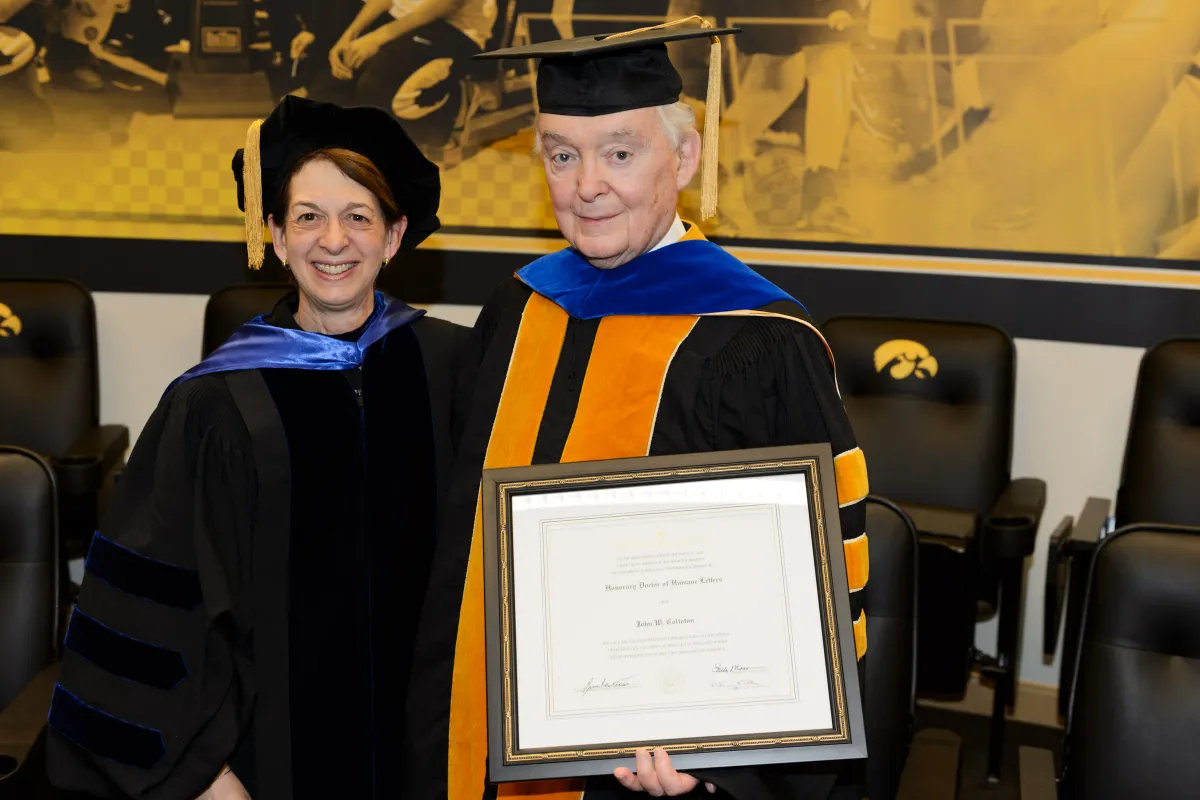
In 2016, he received the UI Hancher-Finkbine Alumni Medallion, one of the university’s highest honors.
Other honors and awards to Colloton include:
- Iowa Medical Society John F. Sanford Award (1979)
- American Hospital Association Distinguished Service Award (1990)
- Iowa Hospital Association F.P.G. Lattner Award (1994)
- American College of Health Care Executives Senior-Level Healthcare Executive Regents Award (1995)
- UI Distinguished Alumni Award in Achievement (1999)
- UI National Varsity Club Honorary Letter-Winner (1998)
- Loras College Distinguished Alumnus Award (1996) and Honor Doctor of Letters Degree (1999)
- The John W. Colloton Chair in Health Management and Policy in the UI College of Public Health, an endowed position established by friends and supporters (1999)
- The John W. Colloton Chair in Cardiovascular Medicine in the UI Carver College of Medicine, an endowed position established by Marvin A. and Rose Lee Pomerantz and family (2007)
Colloton’s ability to work with university administrators, state leaders, and private supporters to overcome obstacles and achieve results drew praise, yet he frequently credited those who helped achieve his goals.
“We were blessed to have generous financial supporters in the persons of the late Roy Carver and Marvin Pomerantz and the ever-generous John Pappajohn [who died in 2023] to help advance our strategic vision,” he said in the 2013 College of Public Health interview. “In addition, then-UI President Sandy Boyd gave us the management tools, organizational latitude, and support to effectively manage through those turbulent times.”
Boyd described Colloton this way to Modern Healthcare in 2003:
“Many leaders are captives of the present,” Boyd said. “[Colloton] kept growing, never reaching a plateau ... the more challenges he faced, the better he got. He wasn’t afraid of anything.”