$266.4M
In external research funding in fiscal year 2025, which includes $137.9 million in National Institutes of Health funding
From fundamental discoveries to clinical breakthroughs, we’re committed to pushing the boundaries of biomedical discovery — turning scientific insights into real-world solutions that elevate patient care today and redefine what’s possible tomorrow.
Cystic fibrosis (CF) is a genetic disorder that damages the lungs, pancreas, and other organs, making it extremely difficult for people with CF to breathe and get adequate nutrition. For decades, it was considered a terminal illness, with many patients not living past their teenage or early adult years.
As a physician-scientist studying CF, Michael Welsh, MD, was interested in how cells produce and maintain a thin, protective layer of mucus to capture and flush away bacteria and other irritants from the lungs. In people with CF, this mucus is sticky and clings to cells instead of “bathing” them — clogging airways and contributing to recurring lung infections. It also affects the pancreas, blocking the flow of enzymes and disrupting digestive processes.
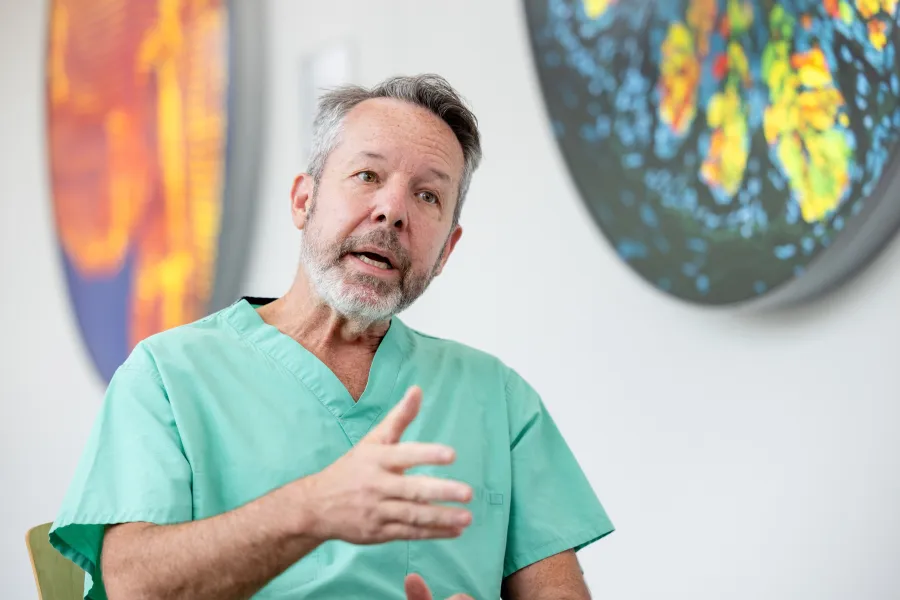
This year, researchers at Iowa, led by pulmonologist David Stoltz, MD, PhD, were awarded a five-year, $11.8 million grant from the National Heart, Lung, and Blood Institute, part of the National Institutes of Health, to study primary ciliary dyskinesia, a rare genetic disorder characterized by chronic respiratory infections. Stoltz and colleagues will take a research approach similar to his and others’ work that led to the breakthrough in treatment for cystic fibrosis.

Diagnosed as a child with cystic fibrosis, Grace Lidgett of Traer, Iowa, has never taken breathing for granted. Today, thanks to the drug Trikafta — a therapy based on groundbreaking cystic fibrosis research at Iowa — she is pursuing dreams she once feared she wouldn’t live long enough to realize. She’s a college student, an avid runner, and a participant in studies to help improve CF treatments. “Research means opportunity,” she says. “To take a full breath and fill my lungs with air, rather than illness, means everything.”
University of Iowa Health Care's Annual Report