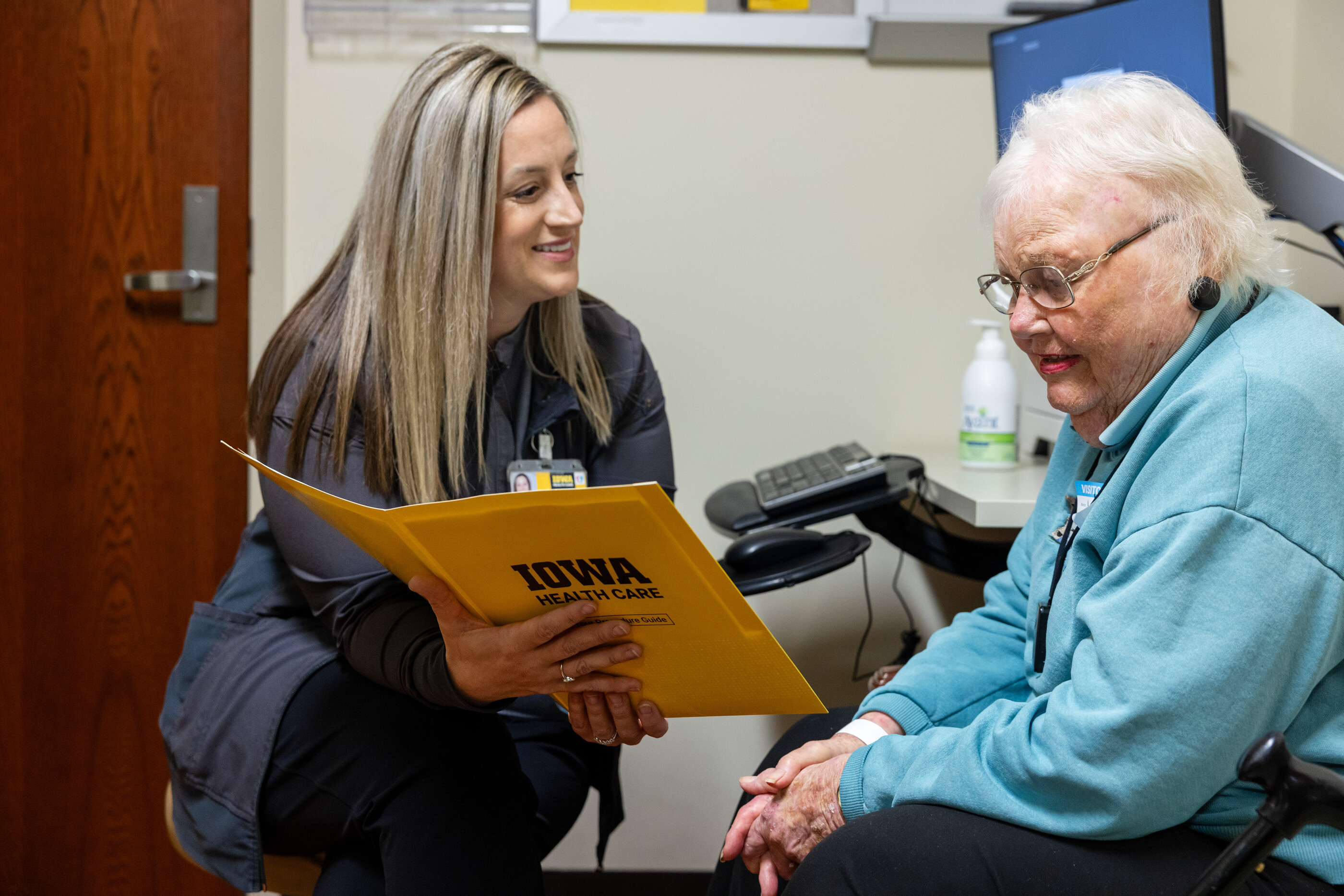
Clinical trials offer access to the latest, most advanced treatments. Understanding how they work and what to expect can help you make an informed decision.
University of Iowa Health Care is reopening a once-closed inpatient unit at its downtown campus as part of its continued commitment to enhancing community health care. The space has been renovated into an inpatient family medicine unit that will welcome its first patients this July. Commonly referred to by staff as 3 Center, the 26-bed unit closed several years before UI Health Care assumed…
Former University of Iowa punter Nick Phelps knew it was bad as soon as he hit the ground. A teammate trying to block the ball during a punting drill in October 2021 had instead collided with him shin-on-shin. “When I lifted my leg up, I could see bone sticking out, and where my toes were supposed to be, I saw my heel. My leg was in an L shape,” he says.
Brian Dlouhy, MD, a neurosurgeon at University of Iowa Health Care who specializes in Chiari malformation and complex craniovertebral junction abnormalities, has seen firsthand how these conditions can impact lives—from babies to seniors.
When an injury stands in your way, recovery can feel like a long and daunting process. Yet, with the right tools and resources, you can recover like a pro athlete.
University of Iowa Health Care's Medical Toxicology Clinic opened last summer to help meet the ongoing medical needs of patients exposed to toxic substances.
In 2019, Lisa Dickerson of Newton, Iowa, was celebrating the Fourth of July with family and friends when a firework unexpectedly malfunctioned, setting off a series of explosions on the ground. Dickerson was hit directly in the face and burned badly.
A pair of white Birkenstock clogs sits on a shelf in Suzy Hammer-White’s office. They’re falling apart, soles worn down to the cork, and wrinkled in a way that suggests they’ve seen miles of hospital hallways.
As the Fourth of July approaches, ophthalmologists at University of Iowa Health Care are reminding Iowans to celebrate safely and be mindful of the serious risk fireworks can pose to eye health.
“The food we eat is fertilizer for our microbial garden,” says Terry Wahls, MD, a clinical professor of internal medicine. “If you eat more fruits and vegetables, you’re fertilizing health-promoting bacteria. But if I’m inhibiting those helpful microbes by having lots of sugar, lots of white flour, lots of food-like chemicals, then I may be fertilizing new bacterial species that are creating…